General · May 19, 2026
Open Finance Is the Only Path Forward
The era of Open Finance has begun and Plume is leading it.
DeFi hit its ceiling. Open Finance is what comes next.
DeFi let down its believers, it was a grand experiment that broke too many things to reach beyond the speculative lab. Risks were everywhere, from the sudden asset depegs to the seemingly never-ending smart contract exploits.
But the story of onchain wealth creation isn’t over, it’s simply evolving. It’s no longer about speculation and synthetic tokens,it’s about tokenizing what is tangible: financial instruments, receivables, credit, commodities, and cash flows. We are finally bridging the gap between blockchain rails and the $900 trillion global asset market.
What was once a whisper at the margins of crypto has become impossible to ignore. Tokenized real-world assets are reshaping priorities across the industry, and a new financial model is emerging around them.
The era of Open Finance has begun and Plume is leading it.
Lessons From DeFi: The Good and the Bad
DeFi delivered some of the most significant breakthroughs in financial technology of the past decade. Programmable money and transparent access improved existing markets and redefined what markets could be.
Composability proved its worth. I remember when "crypto" meant little more than trading memecoins and refreshing price charts. Then the mental model shifted entirely.
On Solana, protocols like Jupiter, Kamino, and Jito demonstrated how innovation could compound in real time. One protocol aggregates liquidity, another builds yield strategies on top of it, while another layers staking incentives into the same system. Each protocol inherited capabilities from the last, creating an ecosystem no single institution could have designed alone.
For the first time, people could borrow against their assets without surrendering control to a centralized institution. Capital began moving at software speed. Innovation fed on itself, and the result was an entirely new onchain economy.
This is the real innovation of DeFi and shouldn’t be abandoned as we look to what’s next.
What should be acknowledged is where it went wrong.
From Kelp DAO's $300 million exploit to the contagion of the Terra collapse, the financial system of DeFi has repeatedly exposed the same hard truth: it wasn't built with the safeguards needed to scale or survive contact with the real world.
Stablecoins depegged. Billions evaporated overnight. What was designed to be the bedrock of onchain finance proved to be some of its most fragile infrastructure.
Alongside that, the ecosystem accumulated layers of degraded assets. Wrapped versions of wrapped versions, each one stacking risk on the same underlying, obscuring exposure until it was too late. The complexity wasn't innovation but rather fragility wearing a technical disguise.
Not only was the technology less than sound, compliance and custody were treated as afterthoughts. The cultural context of DeFi’s early builders meant a premium was placed on self-custody and personal due diligence.
The ethos was radical ownership, and for a time, it was exciting and highly rewarding to find new unique farming opportunities that were easily 100%+ APY that it felt like you wholly owned.
But what has become clear is that expecting the broader world to adopt that mindset was always unrealistic. Finance at scale requires guardrails and accountability. Building a system that ignores both was never disruption.
Crucially, without those foundations, institutional capital remained offchain and users stuck with bad options.
The Customer's Forced Choice
Today, customers are caught between two flawed options:
DeFi offers openness, composability, accessibility, and continuous markets, but often at the cost of security, compliance, and consumer protection.
CeFi offers regulation, safeguards, and institutional trust, but remains closed, fragmented, jurisdiction-bound, and inefficient.
Users seeking programmable yield are pushed toward systemic risk. Users seeking safety are pushed toward friction and exclusion. No model fully works.
Open Finance is what happens when customers stop being forced to choose.
What is Open Finance?
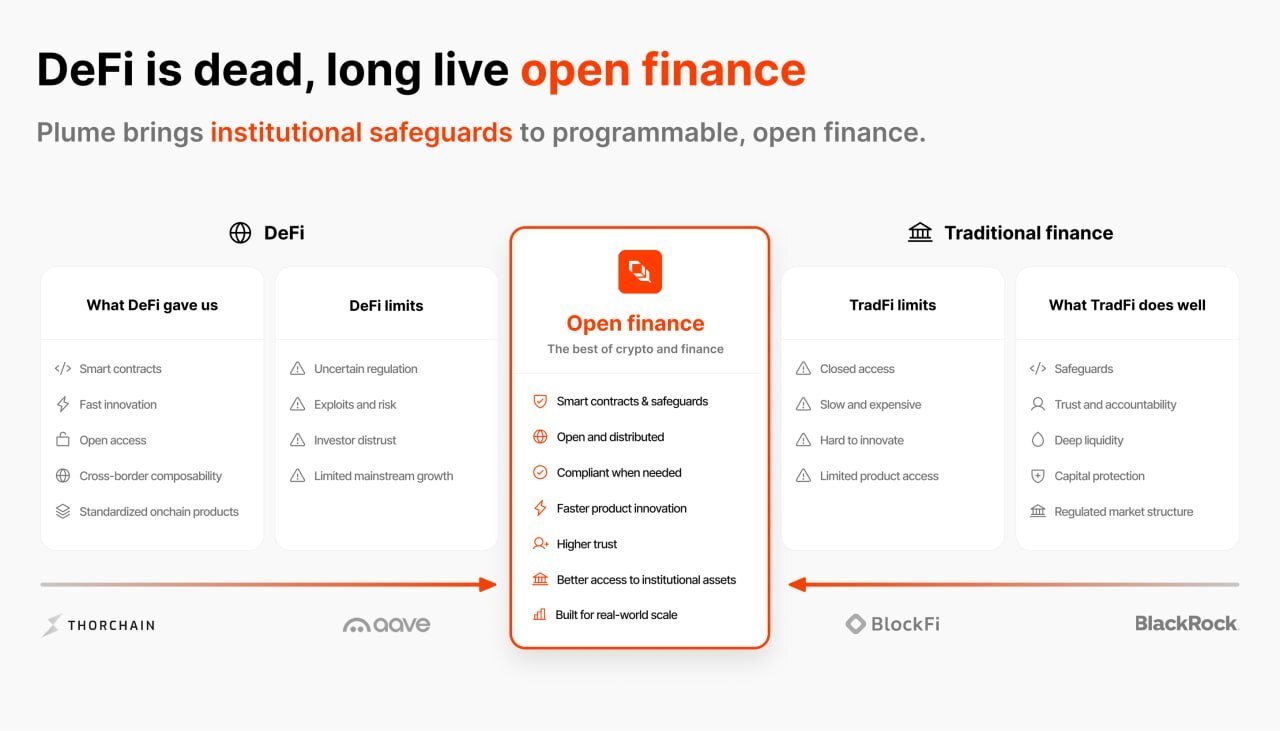
Open Finance is the synthesis of DeFi and CeFi. It brings the safeguards, compliance, and permissioning that institutional capital demands together with the programmability, innovation, and accessibility that onchain markets uniquely enable. The best of each with a focus on capital safety.
Programmability was always the promise. Assets that move at software speed, compose with other onchain primitives, and participate in markets without anyone having to manually intervene. That promise was real, it just needed a foundation worthy of it, and Open Finance is where it finally lands without degrading the underlying asset in the process.
Compliance isn't a constraint here, but rather the architecture. Permissioning, KYC, and regulatory oversight are built in from the ground up, not patched on after the fact. The financial standards that the world's largest pools of capital were built on aren't obstacles to work around but more so the reason institutional money can show up at all.
Accessibility doesn’t just mean open for those who know how to use a hardware wallet and understand slippage. It is globally available, without being bound to a single jurisdiction, intermediary, or gateway. Infrastructure that anyone can build on and anyone can benefit from.
Most importantly, it introduces durable trust. The one thing DeFi could never quite manufacture.
Open Finance builds trust through regulated asset managers, custodians, and verified oracles. Real-world assets sit inside bankruptcy-remote structures designed to survive counterparty failure. The kind of infrastructure that doesn't need to ask you to trust it, because the structure speaks for itself.
These are the precise conditions institutional capital requires to move onchain at scale. Open Finance is the missing bridge, the architecture that connects institutional credibility to onchain capability.
Plume is Open Finance
The time for Open Finance is now.
The tokenized asset market is projected to reach $18.9 trillion by 2033, and the early numbers are already telling a compelling story.
Today, roughly $15.36 billion in tokenized U.S. treasuries exist onchain against a broader treasury market worth more than $30 trillion. The market remains at the beginning of its expansion curve, and the gap between where we are and where this market is going is the largest untapped opportunity in modern finance.
Tokenization has quietly matured. When I went to crypto events in 2021 all you would see is hoodies, sneakers and the odd t-shirt with a moon on it. Today, it’s a sea of suits and this shift is not only cosmetic. It's a signal that the biggest names in global finance have arrived.
Apollo with over $700 billion in assets under management, WisdomTree with nearly $100 billion, Hamilton Lane managing more than $900 billion, Fidelity overseeing $4.9 trillion are all invested and involved. These are the firms that manage the world's wealth, and they're here and they’re working with Plume.
The regulatory picture is catching up too and we are at the forefront, doing the hard work.
We secured our SEC transfer agent license,one of the most difficult regulatory milestones in digital asset infrastructure. Our General Counsel, Salman Banaei, has testified before the House Committee on Financial Services as policymakers shape the frameworks that will define this market for years to come.
With our BD/ATS structure coming and more discussions with regulators on the way, we're assembling the full regulatory infrastructure that institutional capital needs to move with confidence.
With all these previously-inaccessible assets coming onchain compliantly, we’re building a new world for retail.
For the first time, distribution channels that were built for everyday investors, like wallets, exchanges, and neobanks are gaining access to the kind of US institutional assets that were previously reserved for the privileged few.
This shift arrives at a moment when confidence in purely speculative DeFi systems has weakened. Capital is increasingly searching for safer, yield-generating onchain assets backed by real economic activity.
That is the opportunity Plume is built to serve. Our institutional grade products on Nest, our flagship yield product, is where institutional capital wants to land.
Capturing this opportunity requires more than a single product or point solution, and our full-stack ecosystem is built for tokenized assets to move seamlessly between issuers, institutions, and global investors.
The next era of finance will not be defined by the divide between DeFi and traditional finance.
Open Finance is finally here.

Open finance together
Work with Plume to issue, distribute, and manage real-world assets.