General · May 29, 2026
Plume Update: Q1 2026
Q1 2026 was the quarter Plume took its work as a network further, from simple deployment to putting real world assets to work.
Q1 2026 was the quarter Plume took its work as a network further, from simple deployment to putting real world assets to work. In Q1, we grew our footprint, deepened the institutional flywheel, expanded distribution into the channels that actually move retail and institutional capital, and continued building global regulatory touchpoints that are crucial for the next phase of asset tokenization growth.
- RWA Leadership: We ended Q1 with $340M in RWA TVL and continued to lead the RWA category in holders even compared to other large chains like Solana and Ethereum. Nest, our flagship yield engine, grew to $50M in TVL, with productive, monetizable strategies driving the bulk of growth.
- Distribution Activated: Phase 1 integrations with EtherFi with a $25M allocation into Nest and Perena (on Solana) were initiated as the year kicked off, with Phase 2 of these integrations beginning in the next quarter.
- Asset Suite Expansion: While there are an abundance of assets coming onchain, they are still often mismatched with what users want. We’ve been focused on a barbell strategy to address the spectrum of onchain users – safe, familiar assets as well as higher yielding ones. Our Crypto Basis vault (nBASIS) which is safe & familiar reached $25M while our BlackOpal vault (nOPAL) which houses higher yielding & loopable assets grew organically from $2.2M to $14.1M.
- Regulatory Participation: We advanced a multi-jurisdictional regulatory participation, including presence during a U.S. House of Representatives hearing on tokenized securities legislation and US Capital Markets, and a letter to the Bermuda Monetary Authority advising on asset tokenization.
- Korea Expansion: We expanded its focus in Korea, achieving productive milestones including launching the KRW1 stablecoin onto the network.
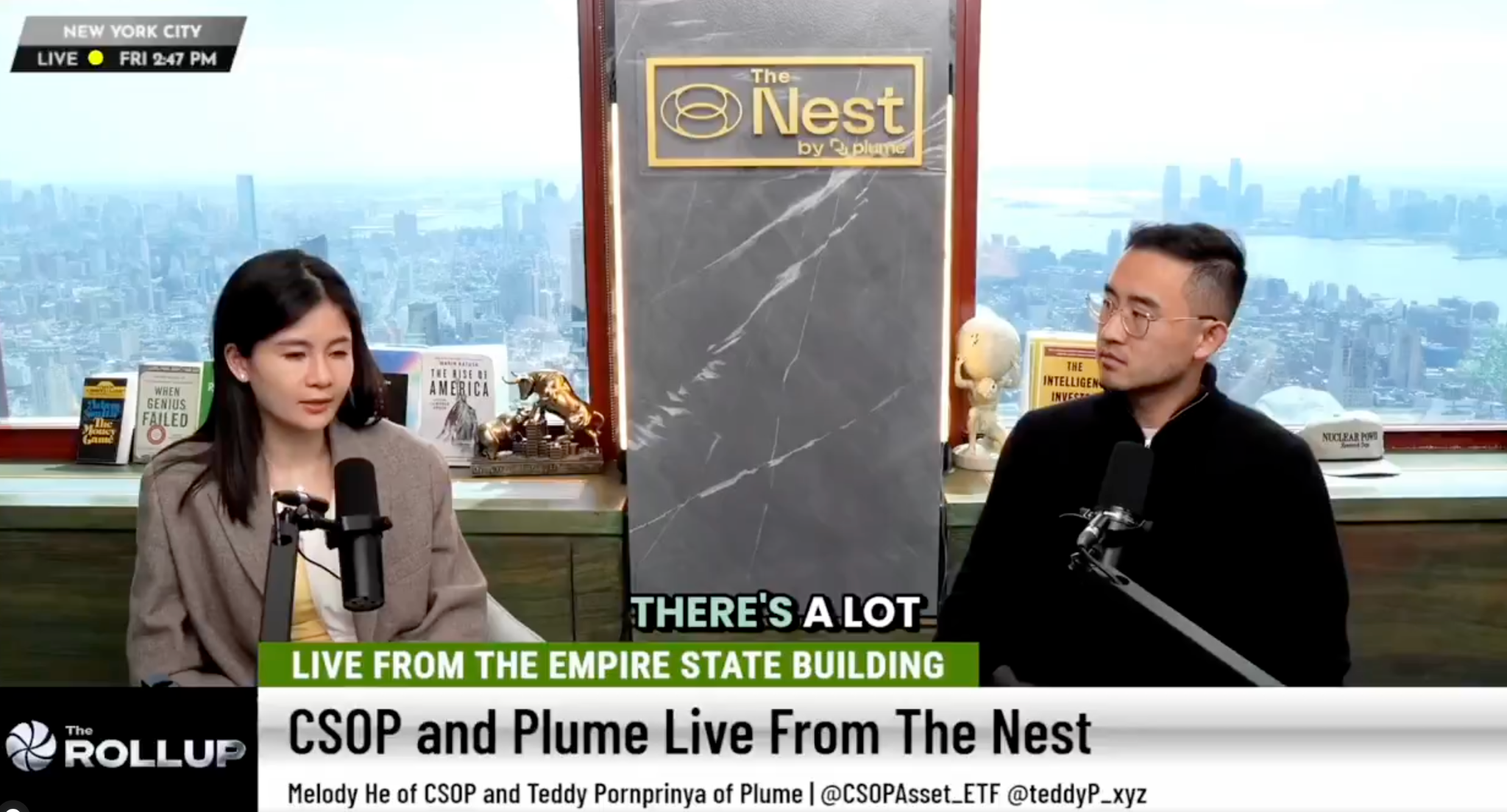
- Brand and Earned Media: We focused on foundational information and launched RWA Academy as a structured educational series on tokenized finance, and debuted The Nest podcast studio from our Empire State office in partnership with leading blockchain media house, The Rollup.
Basic tokenization kicked off the interest in RWAs and now Plume is focused on what comes next. The focus is on how to take these onchain assets and make them productive in the way institutional and retail investors value.
Letter from the CEO
The first quarter of 2026 was where tokenization really took front and center stage. As we’ve said before, tokenization is one of those things that doesn’t quite shine in a crypto bull market. The inflated onchain yields coupled with the familiarity of existing onchain protocols keeps people using what they already know, even if they know it won’t last.
At the end of 2025 and into Q1 2026 we saw the end of that run. When tokens were generally underperforming during the last quarter of 2025, users switched from maximum risk on behavior towards safer and stable yields.
The world of tokenization had another impressive quarter with over 30% growth in total value onchain over the last three months. This growth took place while everything else in crypto was shrinking. This pushed retail and institutional users alike to pause and really take a look at the state of the market.
In tandem with the overall downturn, the catalyst was the series of exploits and depeg events happening across major DeFi protocols. This was the last straw for many crypto natives as the risk of holding money in onchain defi protocols was no longer worth the rewards. Risking your capital to earn yields that were barely above the risk free rate just no longer made sense when you could now get a similar or better yield by allocating to onchain RWAs through protocols like Nest or many other great RWA protocols.
While this is a great narrative, as per usual in crypto, reality doesn’t quite align. While the value of real-world assets are up, if you dig a little deeper it is clear that usage is not. The number of users participating in the sector hasn’t meaningfully changed. This can be attributed to limited utility, awareness, UX, attractiveness, and understanding of the assets. Markets for tokenized RWAs are still small across DeFi protocols and even within those there is not much that can be done with these assets once they are onchain. And as with lots of things, even if the product is right it simply takes time for users to get comfortable with it. When we started Plume, the vast majority of people we spoke to were unwilling to allocate to treasuries. 3 years later with no fundamental change to treasuries (outside of yields actually being lower now) treasuries are now accepted as the de facto onboarding asset for tokenized assets.
While some see this as a negative, I don’t. Since starting Plume, there has been one constant - the continued growth of onchain real world assets.
Tokenization is a freight train that will not slow down. Just look at stablecoins. As more and more money continues to come onchain into stablecoins, those stablecoins will need something to do. Payments is one obvious beneficiary. The other is tokenized assets.
In parallel to the technology is regulation. Every quarter there are new massive moves in regulation across every major jurisdiction in the world that continues to open up more and more of the market for tokenized digital assets. We’ve been pushing aggressively in this way as the next wave of growth in this market is about onboarding new assets, new users, new markets, new capital. People don’t yet realize how big this market is and it will explode when the floodgates are opened. We are one of the projects investing heavily in positioning ourselves for this growth.
In the United States as we continue to march forwards toward Clarity, our General Counsel Salman Banaei was invited to DC to testify alongside the execs at SIFMA, NYSE, DTCC, and The Blockchain Association to discuss the future of tokenization in the U.S. Each unlock not only brings a whole new part of the market onchain, but is permanent with ripple effects across the rest of the world and the rest of finance.
Could not be more bullish for the future. The work has only just begun. Onwards!
- Chris Yin, CEO and Co-Founder of Plume
State of the Tokenization Market
Tokenized assets grew 30% in a single quarter
Total tokenized RWA value grew from $21.4B to $27.9B in Q1, driven by a small handful of large funds concentrated in T-Bills, commodities, and credit.
- US Treasury Debt: $8.9B → $12.8B (+43%)
- Commodities: $3.6B → $5.3B (+47%)
- Asset-Backed Credit: $2.2B → $3.2B (+46%)
- Non-US Government Debt: $773M → $1.17B (+51%)
- Diversified Credit: $453M → $668M (+48%)
User growth is still growing, but at a much slower pace
While the growth in value for onchain assets is incredibly exciting and bullish, it is merely a single metric. We need to pair that with other metrics to give us a more complete picture of the true state of onchain tokenized assets. One obvious metric that complements this is about how many users are holding these assets. And this is where the picture is less rosy. There has been some growth in this number going from 576,873 to 713,814 users holding RWAs over the quarter which represents a 23.8% growth. While still admirable, the value that is being driven by these holders is still concentrated in the hands of a few wallets and so we still have more work to do here!
Institutional and crypto-native rails kept converging
While initially institutions looked at exploratory pilots, BlackRock, JPMorgan, Fidelity, Franklin Templeton, State Street, UBS, Goldman Sachs, BNY Mellon, HSBC, and Citi are now all publicly active in tokenized RWAs.
Across the quarter, small updates and announcements showed this shift, with JPMorgan launching MONY (My OnChain Net Yield Fund) with a $100M initial seed for JPMorgan's first publicly-marketed onchain yield fund. Morgan Stanley announced an institutional digital wallet for tokenized assets. Citi laid out a unified-safekeeping framework that would put US Treasuries, foreign bonds, tokenized money market funds, and bitcoin under a single master custody account with cross-margining between digital and traditional assets.
Plume’s Q1 Review
Mainnet and Nest Growth
Overall this quarter focused on building new growth opportunities through higher yielding more esoteric assets, institutional anchors, and providing an answer for those looking for opportunities outside of DeFi.
Distribution as the Priority
Distribution was Q1’s single biggest priority. We quickly developed three core channel categories: exchanges, neobanks and chains.
- Neobanks: The start of our integration with EtherFi began, featuring the first $25M of a $100M commitment.
- Chains: Perena went live on Solana, with the team working on due diligence to find others that align with our focus on security and compliance.
Our Onchain Asset Manager
This quarter we also took our asset suite further, rounding out into an onchain asset manager rather than individual products.
We continued to build the foundation of trusted, established assets with steady yield while pushing further out into looping-optimized and esoteric strategies that the rest of the market simply doesn’t offer.
- nBASIS: $25M and growing. This asset has continued to be the onramp and onboarding tool for many crypto natives into RWAs. People are familiar with the basis trade already and so it’s a great starting point for folks but then as they get comfortable with Nest and the other products we have here, they begin to look towards diversifying into new assets and we are currently in process with several folks on this expansion now.
- nOPAL: $2.2M → $14.1M, up 541% in the quarter. We’re seeing strong organic interest with lots of people posting about this asset and how it can be used onchain, how to loop it, etc. parties. As with all esoteric assets they need time to grow onchain and get people familiar with the asset class but we’ve been very happy with the excitement around the asset.
- We have several new assets that are live but have not been announced yet and looking forward to sharing more of them soon!
Setting the Standard in Regulatory Engagement
We continued to build the most credible, multi-jurisdictional regulatory footprint in tokenized assets. This isn’t a side project for us but one we believe goes hand-in-hand with building the best open finance platform possible.
Every license and registration unlocks a new asset class, a new distribution channel, or both. Equally important, Q1 was the quarter we moved from being regulated to actively shaping regulation by directly contributing to the policy conversations that will define onchain finance for the next decade.
- Invited to the U.S. House Financial Services Committee. Plume was invited to participate in the most significant congressional examination of tokenization to date, contributing directly to the dialogue on tokenized securities, capital markets structure, and the legislative path forward. Congress is no longer debating whether tokenization should happen, it's debating how, and we are now in the room for that conversation.
- Written guidance to the Bermuda Monetary Authority. As Bermuda finalized its framework for digital asset infrastructure, Plume submitted formal written guidance to the BMA on the regulatory treatment of tokenized real-world assets, onchain transfer agency, and infrastructure-layer licensing. Bermuda has emerged as one of the most thoughtfully constructed offshore regimes for institutional onchain finance, and we're shaping it from the inside.
Product and Engineering
In Q1 we rebuilt the foundations of our yield protocol, Nest, completely. Our focus was on redesigning from the ground up to make onchain asset management more transparent, reliable, and scalable than anything that exists offchain.
Nest Redesign
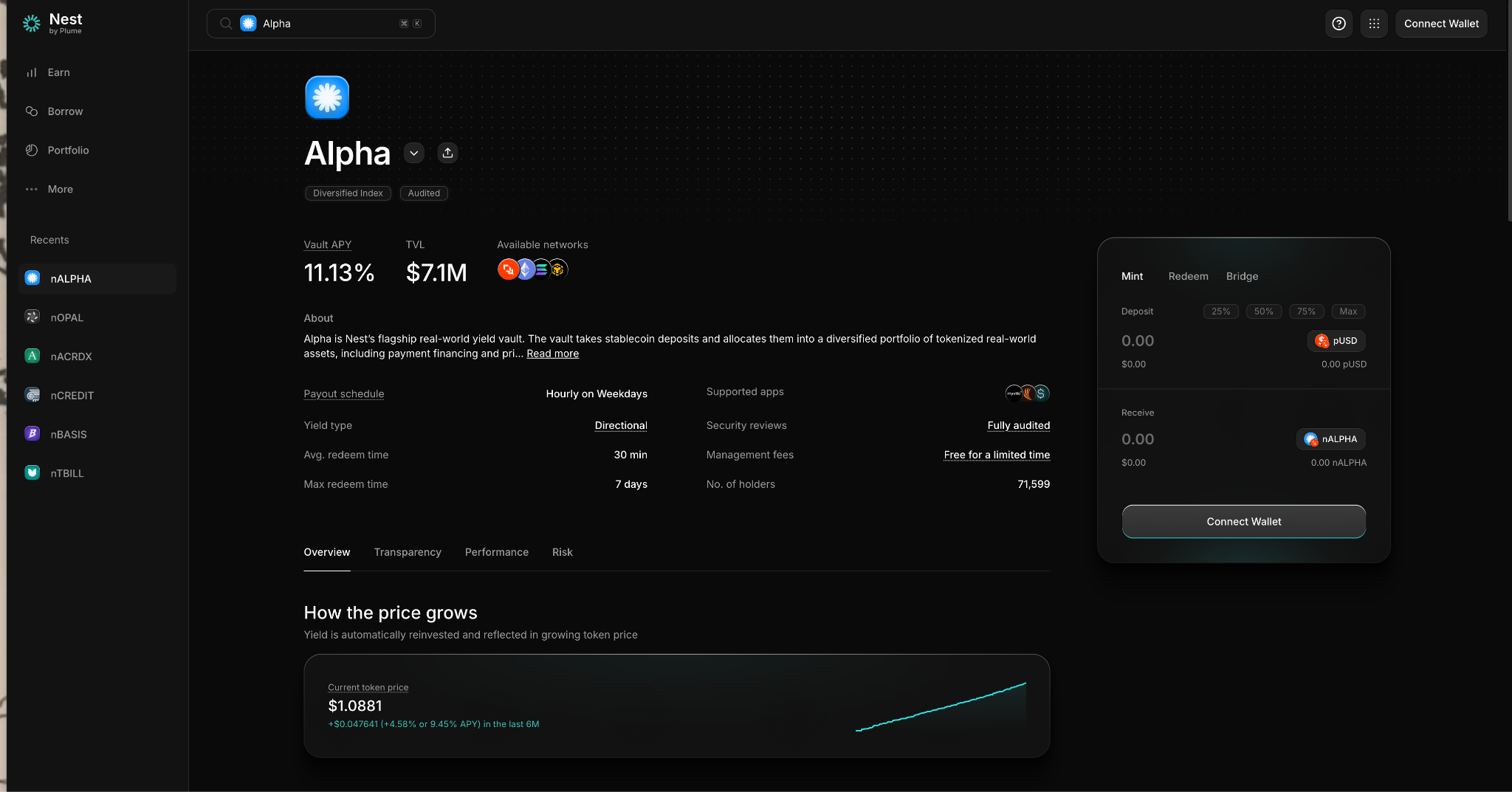
The new interface brings deposits, yield, and positions into a single, unified experience. Users can now see exactly how their capital is deployed, what they're exposed to, and where returns come from. Every vault surfaces real-time NAV, asset composition, counterparty exposure, redemption mechanics, and historical performance. While this ensures we’re compliant, it crucially makes the experience of Nest better.
Nest Studio
Nest Studio is the operating system running behind the scenes. It standardizes everything: how assets are issued, managed, and operated, from vault deployment and pricing to purchase and redemption flows, compliance hooks, and operational reporting. What used to take months now takes days, making it easier than ever to onboard new assets and manage vaults at scale as real world assets come on chain.
But Nest Studio isn't just background infrastructure. It also powers the operational transparency that vault managers, regulators, and Nest users all rely on. That means clear visibility into price updates, redemption activity, and portfolio management actions, giving vault managers what they need to make good decisions and giving users a real window into how their assets are being maintained over time. It also covers the compliance reporting requirements that regulators need as Nest continues expanding its licensing.
Most folks don’t realize the operational burden from running vaults. This upgrade is a material improvement for how vaults can be created, managed, maintained, and grown. Not only for us, but we will be exposing these tools for curators and 3rd parties to use soon and also concurrently creating interfaces for agents to easily operate vaults in the same fashion. More to come soon here!
Marketing and Brand
Plume’s brand has grown in strength since mainnet launch, moving to a defined voice for real-world asset insights and education.
RWA Academy
Q1 saw the launch of RWA Academy, an academic series focused on improving understanding and education of real-world assets from the ground up. This series started with the basics, not only of real-world assets but also took a deep dive into the different asset classes currently being brought onchain, like private credit, money market funds and others.
The Nest
We also launched the Nest Studio in our New York offices in collaboration with The Rollup. To date it has seen builders and institutional voices shaping onchain finance discuss core functionalities of this space. Our co-founders regularly provide thought leadership on topics such as unlocking private wealth, institutions onchain and regulatory moves at the SEC.
Guests on the show so far have included leaders from Visa, NEAR, ArkInvest, Chainlink and others.
Media Placements
Plume stayed top of mind in the media throughout Q1, not only with breaking news but also as core commentary for larger stories. We featured in Forbes, Coindesk, The Block, The Defiant and Cointelegraph.
In Korea, we successfully hosted our first official press conference with local journalists to further media education on real-world assets, drawing 33 reporters and generating more than 40 published articles across the country's leading outlets. The session resonated well beyond crypto-native publications, anchoring strong coverage in Korea's most influential traditional and business media including Yonhap News, Maeil Business Newspaper, EDaily, Sidae, and IT Donga. The discussion centered on why distribution, not issuance, will determine the next phase of RWA growth, and on Korea's potential to serve as a two-way bridge: channeling its high-quality assets to global investors while inviting foreign capital into a maturing retail market on track toward full STO institutionalization.
Conferences
Plume never rests and our team was representing, meeting with stakeholders and sharing insights across the globe.
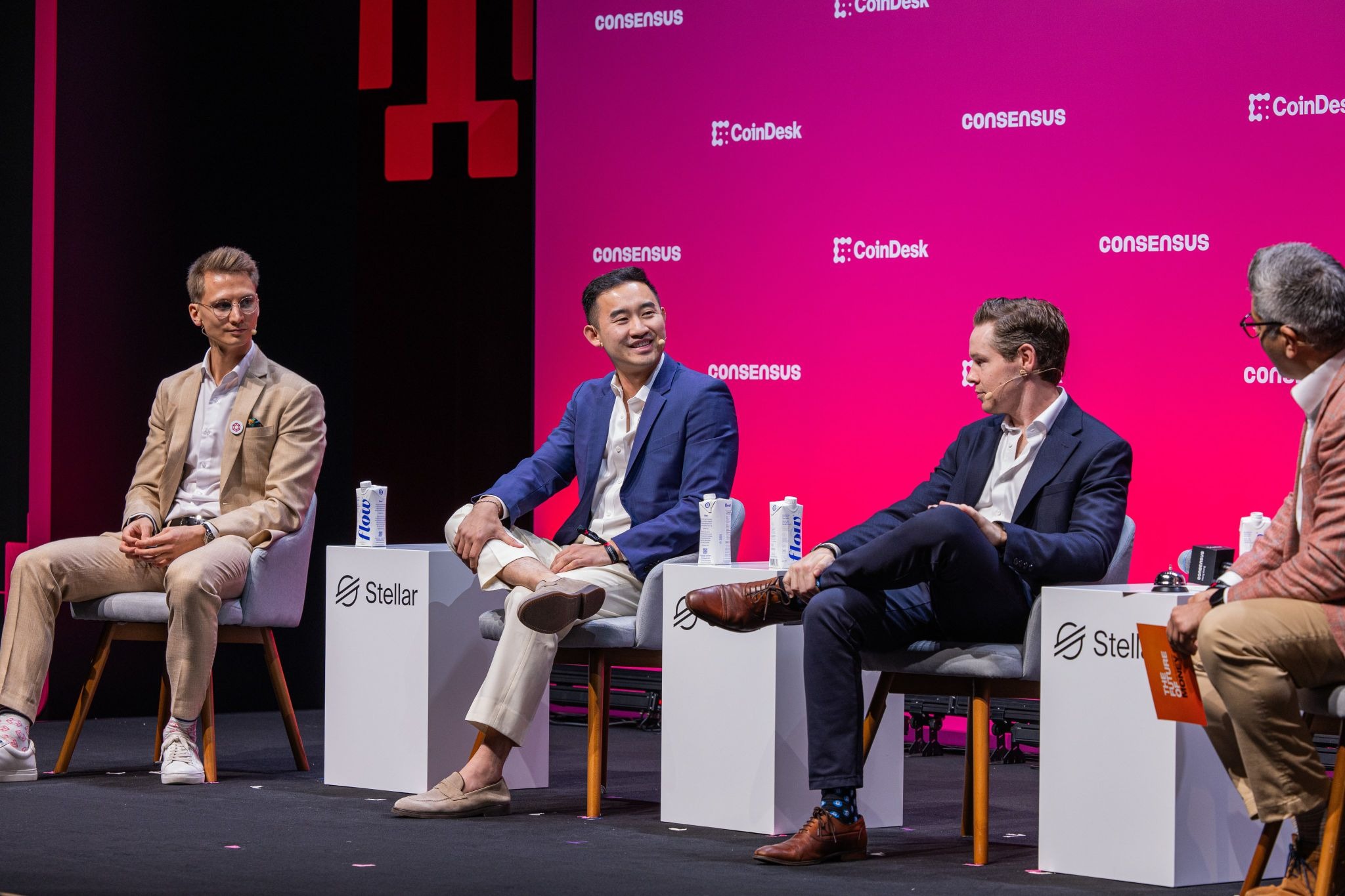
At Consensus Hong Kong, Plume delivered keynotes, led high-signal discussions, and hosted curated events focused on RWAs, DeFi, and the institutional future of tokenization. In Korea, Chris Yin spoke at the World Crypto Forum, sharing his views on why Korea’s volume, behavior, and crypto culture, we see tremendous opportunity for users here to help define the future of crypto, RWAs, and tokenization. The team were in full force in New York for Digital Asset Summit in March hosting a private dinners with institutional partners like Apollo and Re7 and the official opening of The Nest with The Rollup.
Looking Ahead
- Global Visibility: Plume will be present at multiple events across the globe, speaking to institutions about how best to come onchain. From Miami, New York to the UAE expect to see Plume team members sharing insights and shaking hands.
- Regulation: To scale traditional institutional assets onchain, regulation and compliance are key. Alongside the strides already made, Plume is continuing conversations with regulators across the globe, working to be in the conversations with governments as the future of onchain finance grows.
- Distribution and assets: With the solid foundation built, the next phase is on ensuring continued expansion of distribution and onboarding of top-tier assets. Plume is building open finance for institutional assets.
We started Plume around a simple thesis: the world’s assets belong onchain, and they should be open, composable, and secure. Q1 2026 was the quarter that the thesis moved from our conviction to an alignment with the onchain asset space overall.
As always, we’re incredibly excited and grateful to get to continue building in this market with everyone here. Much love and look forward to sharing the updates from next quarter with you all!

Open finance together
Work with Plume to issue, distribute, and manage real-world assets.